Business Analyst or Developer
In the past, the role was often very clearly defined: the developer took care of setting up the process, customizing it, developing extensions, and conducting the discussions to gather requirements. But can such a role still work today?

Table of contents
In this article, we'll look at the changes to roles and see if it makes more sense to define multiple personas.
Introduction
Let's look at the past and how roles were previously handled. Often, it was necessary to customize a business module and make corresponding adjustments to ensure that the business unit met a specific requirement. When this was no longer sufficient, a small additional development or a report had to be written. A table might also have been created to store some customization settings.
The process was relatively simple, all the tools were integrated, as SE80 was primarily used to develop objects and then test them directly in the GUI. The complexity usually arose from the requirements of the specialist department. This meant that extensive coordination and conceptualization were necessary to determine what should actually be implemented.
Rules often didn't play a major, decisive role, because what was implemented was whatever was needed to accelerate or simplify a process. If it was a modification, then it was carried out to create added value for the company. However, this also meant that standard processes might receive less attention. Here, consultants, whether internal or external, were generally able to be effective because they knew their module, they knew ABAP development, and they knew how to implement certain things in the system.
Change
As we have already described in another article, however, ABAP development is changing. The ABAP developer is evolving into an SAP developer, and at the same time, the complexity of architectures and systems is increasing. The public cloud is to be further advanced, which means that there are standardized processes here. Deeper process know-how is needed to be able to introduce appropriate modules, but also to know what these modules can do, how they are operated, and how the department can derive the greatest benefit from them. On the other hand, developers are expected to develop in the cloud, no longer just simple ABAP reports, but applications that are based on Core Data Services and RAP (ABAP RESTful Application Programming Model), which introduces a certain level of complexity into development.
It's time to consider whether the one person who has been handling everything in the company is still the right fit, or whether different roles are needed, each taking on different responsibilities and focusing on specific areas to become highly skilled in their respective fields.
Tasks
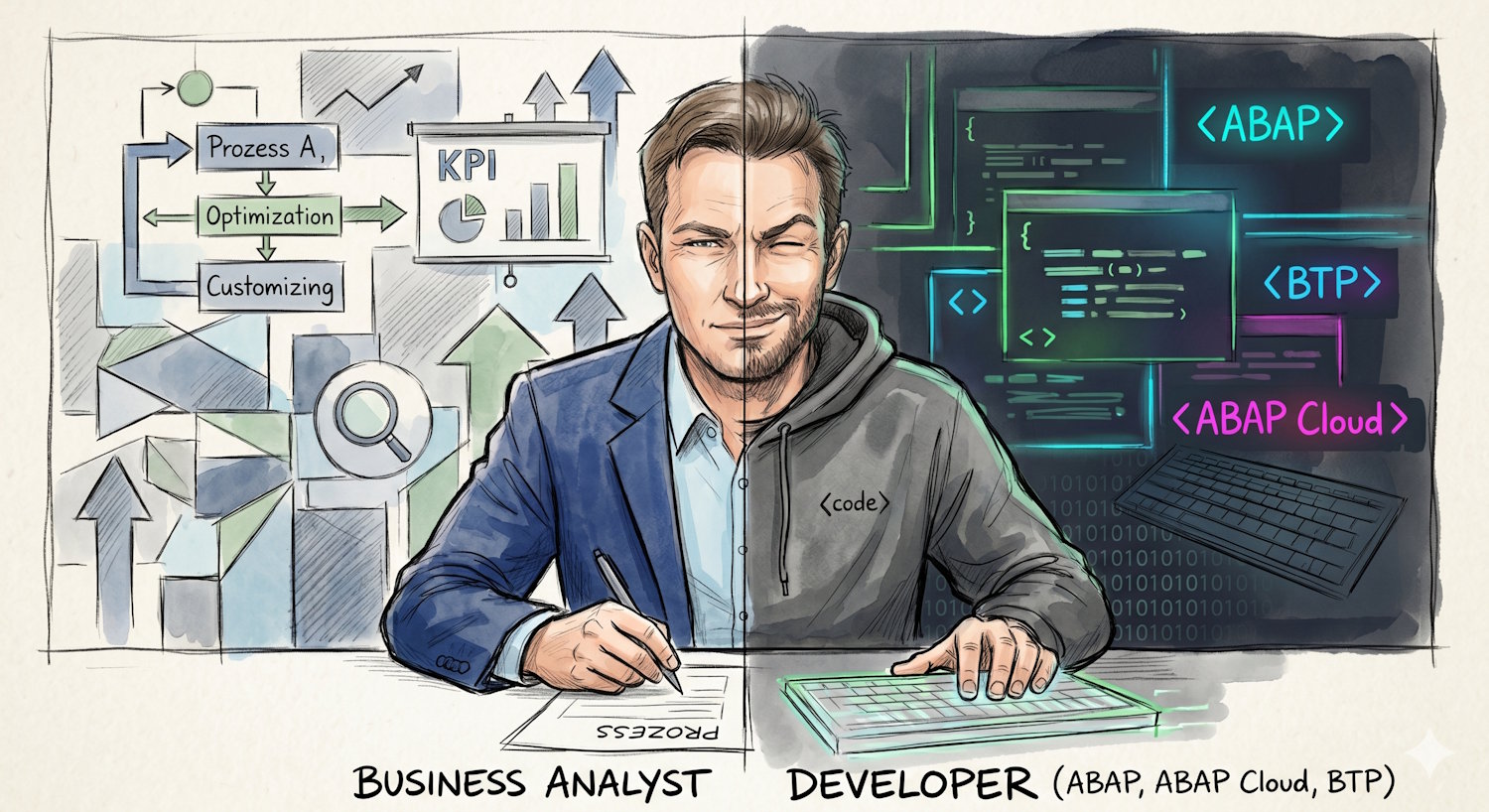
Let's take a look at some tasks and roles that can be identified in this context. We focus on the developer and the business analyst, as they have covered the main processes so far. There are also new roles, such as the architect, who should have an overall picture of the process and keep an eye on the architecture and structure.

Developer
The developer should therefore primarily focus on software development during their working hours, as their role is designed to do. Software development doesn't just consist of writing code and providing an application; there are certain quality standards that we should adhere to so that our software functions better and is ultimately more maintainable. This also includes the topic of Clean ABAP and unit tests, which are still criminally neglected in development today, at least when it comes to the ABAP area.
This, in turn, means an enormous amount of further training for the developer. The topics on the Roadmap for ABAP Cloud are correspondingly diverse, and it takes a considerable amount of time to actually implement them. Then there's the whole topic of modern development. With Fiori applications, we now also have HTTP communication between server and frontend. This means the developer should understand what's actually happening, how the whole thing is evaluated, and how to debug it to find errors.
More and more standard tools are finding their way into software development, such as VS Code as an IDE, which is now also available for ABAP Cloud and Fiori development. This means that learning how to use an IDE is a very big part of modernization, as is understanding and using modern tools like Git, build pipelines, and workflows.
Clean Core plays a particularly important role here. We can no longer use just any technology; we have to modernize certain aspects of our development. If we want to build a classic workflow, we no longer build it in SE80, but instead use a corresponding workflow solution on BTP to implement the workflow. This, in turn, means learning new skills and implementing the processes accordingly in our application. In addition, there are various extension concepts such as on-stack extensibility and side-by-side extensibility that we should learn, as well as the corresponding models to be able to develop software on these platforms.
Business Analyst
On the other side is the actual business analyst, who first has to gather all the requirements from the business department. To do this, they have to conduct numerous discussions and then see how everything can be mapped in the standard. The focus should not be on in-house development, but rather on first examining:
- What processes exist in the standard?
- How are these represented, and can we map our requirements accordingly?
At the same time, it is important to understand certain concepts, such as how Fiori works, what apps should look like, and the underlying concepts. For example, it's pointless to design a Fiori application that looks similar to an SAP GUI application: with too many buttons, too much text, and too much context within a single application. Here, care should be taken to work within standard patterns as much as possible and to use only standard elements that are truly easy to implement. This saves the developer a lot of development effort later on, but it also keeps the application within the Fiori Elements standard, which reduces maintenance costs later.
Another major pillar is integration testing. This primarily involves defining test automation on the UI and between the various applications. The developer takes care of their unit tests, while the business analyst handles the actual tests that test the application itself, as well as the processes between the applications. The burden of test automation should not fall solely on the developer's shoulders.
Requirements
An important aspect of this is collaboration between the different roles and their complementary skills. This allows you to leverage certain synergies to achieve the best possible result in the end. However, you should also be aware that the requirements for external service providers may change as a result. There's no longer one single super-consultant you can hire to implement all your requirements; instead, you likely need equally specific roles and requirements for your service provider to get what you need.
If you want a complete architecture, then you should request an architect. If you want development, then you need a developer. Or is the process first to be conceptualized and refined? Then you need a suitable analyst. The training effort is also incredibly high for external service providers. This means that finding a single person who can fulfill all three roles will become increasingly difficult, or it will have to be compensated accordingly in the future.

Tools
Various tools can already extend the respective roles with additional skills and possibilities today. For example, there are various AI solutions like Joule for Consultants that can support business analysts in defining standard processes, finding areas for improvement, and generally gaining a better understanding of the solution.
AI solutions in the development area, whether Joule for Developers or Microsoft's Copilot, can assist developers in conducting code reviews more quickly, generating specific code components, or better understanding best practices used in the standard.
At the same time, there are static code analyses like CVA (Code Vulnerability Analysis) that help developers identify any remaining security vulnerabilities in the code during the release process. Security will continue to be a crucial aspect of every company, and developers cannot detect all problems. Tools can already help increase productivity and reduce the skills gap.
Training
Generally speaking, training your own people is an important part of skills development and task distribution. This applies to external service providers, in-house consultants, and the relevant business analysts and developers. Everyone needs the new skills in clean core development and standard processes to be able to work efficiently in the future.
The old way of working, based on the motto "I'll just quickly build an extension and modify the standard process" This will no longer work as well in the future as it has in the past and will accumulate more and more technical debt within the company. Therefore, it definitely makes sense to invest money and time in training your own people in order not to fall behind in the market and to remain competitive in the future.
Conclusion
Dividing tasks into different roles certainly makes sense and can increase the company's competitiveness in the future. However, there will still be hybrid roles in the future, where people can be involved in the process at several points without necessarily having to change roles. Such roles have existed in the past and will continue to exist in the future. But fundamentally, you should think about how you can better divide roles within the company in order to work more efficiently and better support future initiatives.