SAP Teched 2026
This year marked the last time SAP TechEd was held in Berlin. Let's look at some of the insights we gained and what stuck with us from the keynotes.

Table of contents
As in previous years, SAP TechEd took place in Berlin. In this article, we take a look at the event and some insights.
Keynotes
The first two days featured the usual keynotes, each given by SAP (CTO, Engineering) and the Developer Advocates. The keynotes were also streamed online and you can find them there to watch again.
Day 1 - SAP
The presentation focused primarily on Joule Work and its use as a tool in everyday work, in collaboration with autonomous agents, and for providing key information and insights. There was also direct integration with CarPlay, allowing tasks to be forwarded directly to the agent while on the go. The collaboration with customers, such as Bosch, was also praised, as they work to develop further use cases and applications. This collaborative work will also be possible with files. SAP also presented Agentic Thinking, where the agent has its own harness, a browser and file access, as well as a Python runtime to provide more tools for its work. An improved version of the Knowledge Graph will also be available to display better insights and relationships. A total of 40 assistants and 200 agents will be delivered, distributed across various departments.
On stage, there was also a demo with Spot, a robot from Boston Dynamics. A problem with a pump was simulated, and Spot checked the machine using a thermal imaging camera. SAP refers to this as Physical AI, where machines use AI to independently take over and complete tasks.
Overall, there were also innovations from various areas:
- SAP Lakehouse (HANA Cloud as a foundation, SAP Dremio, Databricks and SAP Relito for extension and improvement) for evaluating and joining very large datasets with very good performance
- SAP BDC Ontology Manager is now available as a beta
- Governance and traceability for agents and MCP Server
Day 2 - Developers
In the Developer Keynote on the second day, the Developer Advocates took center stage and presented a short story around Agent 0.0.7. Kazimir was equipped with new skills from various areas. First, Joule Work and Joule Studio were examined in detail. A coffee farm was the central scenario, where we had to implement various use cases. Then, various functions were made available via ABAP MCP in conjunction with Claude Code, as this is now possible with version 1.2.0. In the Integration Suite, MCP servers can now be built from OData APIs with just a few clicks, which can then be used by the agents. Overall, the keynote proved to be a well-rounded presentation, and we should now be able to better protect and manage the farm.
Sessions
Generally speaking, we have to admit that we didn't attend that many sessions these past few days, but instead spent more time exchanging ideas in the community area.
Fiori Elements for ABAP developers
This was our session where we wanted to address the topic of Fiori Elements. This focuses on the aspect that ABAP developers are increasingly evolving towards a full-stack approach, but should also be proficient in the various tools within the Fiori environment. We will then make the complete presentation available on YouTube so you can watch it there at your leisure.
Agent-led custom code migration
Our colleagues presented the Custom Code Migration Agent here. This is provided via a separate system in the Business AI Platform and integrated as an MCP server in the developer tools. The migration is based on the ATC Findings. The agent begins working on the cluster of objects and processes the findings. A transport with three tasks is created to cluster the different objects with varying confidence scores (High, Medium, Low). After processing, the developer can review the changes and then incorporate them into the code or adjust them again before activating them. The agent is part of the new Joule 4 Developers offering.
Building AI-infused Applications
How do you, as an ABAP developer, actually get AI functions into your RAP application? This session provided plenty of inspiration on how to do this. First, Recommendations were introduced, which allows you to derive the content for other fields from one field. A function is called, which then calls the LLM and extracts the values. These are then updated in the draft and displayed in the UI with a special blue to highlight the suggestions. The user can then decide whether to accept them. In the second part, applications were shown that, for example, receive an image, analyze the data on it, and populate the entity. The foundation is always the ISLM, which is also available for on-premise systems.
Community
As in previous years, the SAP community was the main focus of the event, at least when we were there talking to various people from the community. Besides the many SAP Champions and SAP Mentors from the program, many well-known SAP personalities were also present. This left plenty of time for exchanging current experiences, networking and getting to know new people, but also to ask questions and gain new insights. In general, we were also pleased with the much larger community area. The feedback from last year was heard, and there were now more seating options, more space, a larger stage, and a Developer Garage to provide more room for discussions.
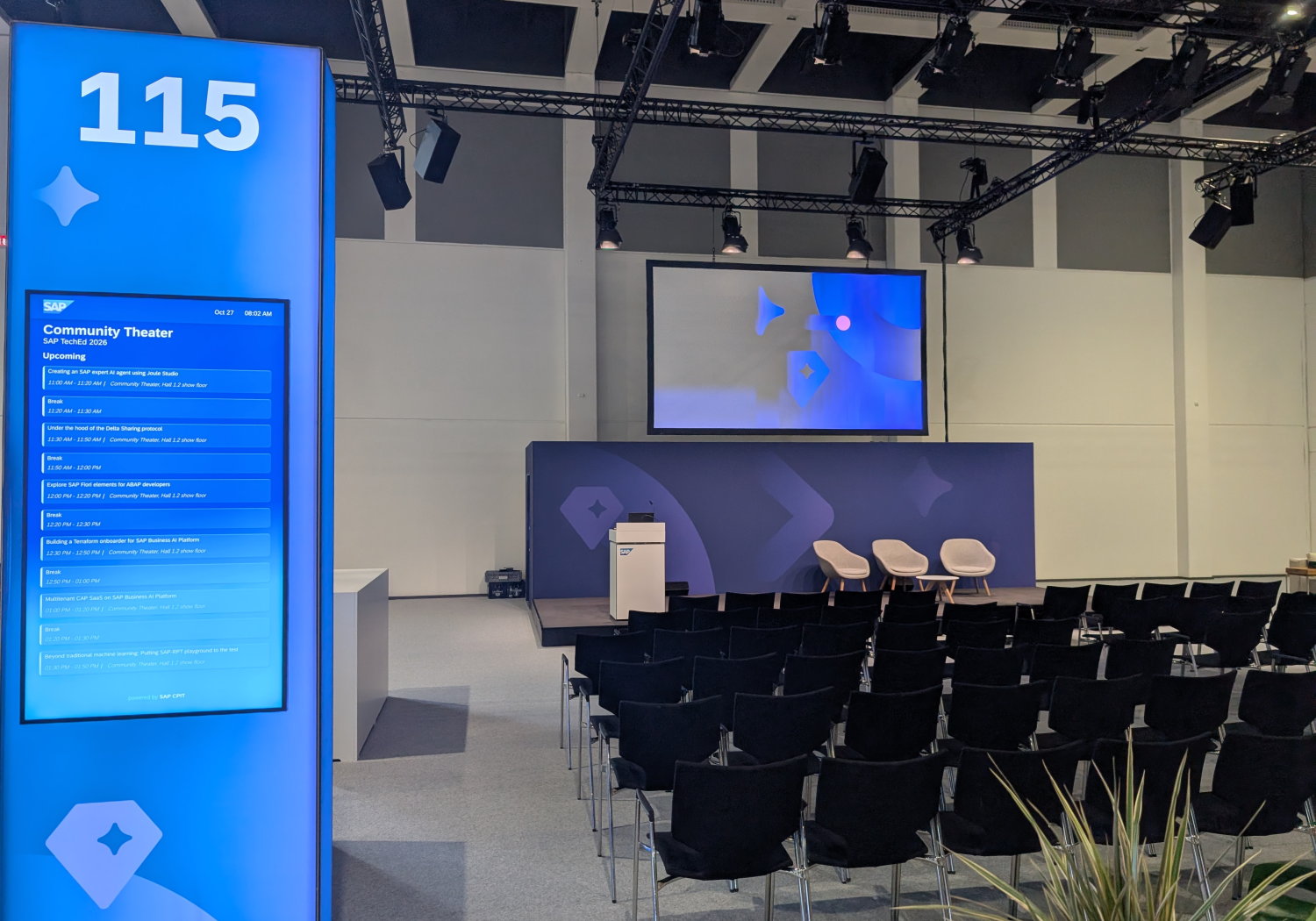
If you couldn't find a session or they were already full, you could at least find someone to talk to in the community area.
Conclusion
Next year (November 2-4), SAP TechEd will take place in Barcelona. The venue has apparently already undergone some renovations, which SAP Sapphire attendees should have noticed. We are curious to see how the event develops and are already looking forward to the next meeting and the SAP community next year.